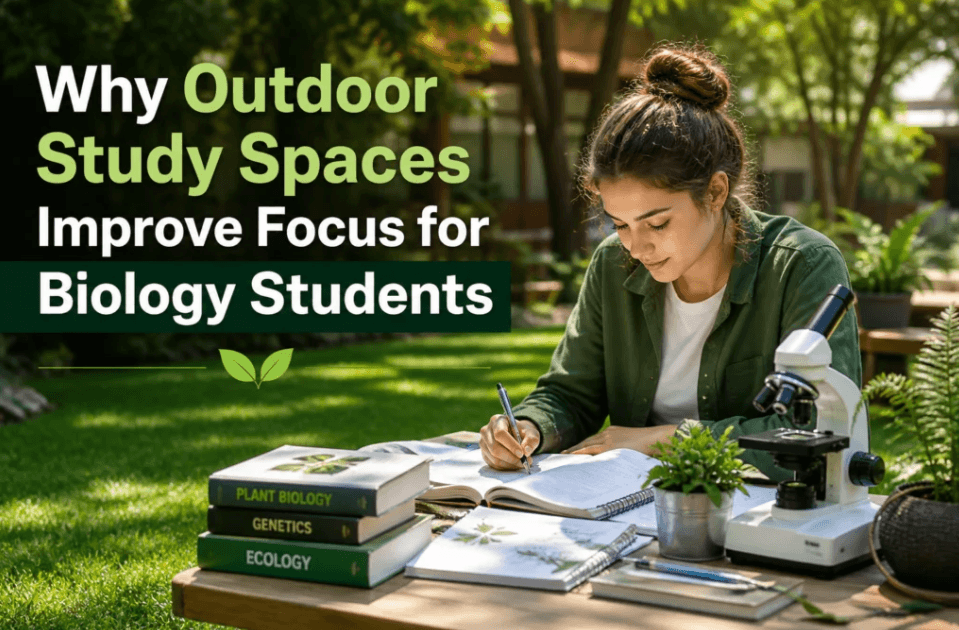
The biology student must manage their time because their schedule begins to fill up with activities that extend until their upcoming week. The multiple demands of labs and fieldwork and assignments and online classes create a complete time commitment for your studies. The situation proves overwhelming for students who search for methods to reduce their stress levels while they maintain their educational progress through resources such as do my online class service. Students frequently forget about this important element which determines their study success: the location where they study. Outdoor study spaces are becoming more popular, especially among students in science fields. The advantages of studying in natural environments provide additional benefits for biology students. Natural environments create an enjoyable studying experience which helps students develop better concentration skills and memory abilities and learning capacity.
The Unique Demands of Biology Students
Biology is not just about reading textbooks. It is hands-on and practical. You need to observe, test and apply what you learn.
A typical week might include:
- Lab experiments that require full concentration
- Fieldwork in outdoor environments
- Research assignments and reports
- Online classes with strict deadlines
Switching between all these tasks can be exhausting. When you study in the same indoor space every day, it can make things worse. Distractions build up and your focus drops.
That is where outdoor study spaces can help.
How Green Spaces Help Your Brain
The first observation shows how people feel more refreshed after spending time in nature. The first observation proves that the result occurs because of a direct cause.
Your brain uses natural environments to recover from mental exhaustion. The process is known as “attention restoration”.
When you study outdoors:
- Your mind feels less tired.
- You can focus for longer periods.
- You understand information more clearly
Outdoor spaces provide mild sensory experiences through their combination of natural light and fresh air and outdoor sounds. The elements enable your brain to recover because they maintain a safe level of stimulation.
The experience is more intense for biology students because they can study nature in its natural environment. The experience lets you study nature directly instead of learning about it from books.
Why Outdoor Spaces Improve Focus
Your ability to concentrate requires two elements, which include your determination to focus and the environmental factors that influence your work. People study better in outdoor spaces which contain landscaped gardens and turf areas because these spaces create a suitable study environment.
1. Fewer Distractions
People indoors face difficulties because screens and noise and clutter create interruptions. The outdoor environment provides people with a more peaceful atmosphere. People find it simpler to maintain their current state of being.
2. Better Mood
Natural sunlight and greenery add a lot of direct impact on your mood. Improve your mood with better energy to stay motivated.
3. Stronger Memory
Changing your study environment helps your brain to retain information more effectively. Indoor and outdoor study activities create superior mental connections for students.
Why Turf and Landscaped Areas Matter
Not every outdoor space works well for studying. Comfort matters.
That is why landscaped spaces and artificial turf areas are so useful. They provide:
- Clean and stable surfaces
- Comfortable places to sit
- Low-maintenance greenery that stays usable all year
You do not have to worry about mud and uneven ground and discomfort. Your complete work efforts can now proceed without any interruptions.
The outdoor areas provide better educational and relaxation spaces for schools and campuses and residential areas.
Balancing Fieldwork, Assignments and Online Learning
Biology students must handle multiple tasks throughout their academic programme. Fieldwork requires students to spend multiple hours or complete entire days of their time. Students spend their time between completing assignments and attending their online classes. The process of achieving balance needs to be established during this time. Students find outdoor study spaces helpful because they improve their study efficiency while decreasing their stress levels. Students seek additional assistance when they face challenges that exceed their current handling capacity. Students facing demanding situations might consider taking my online biology class with expert guidance as their best choice. Students can complete their work while concentrating on their practical learning activities. The system of learning needs to be customised to fit the needs of each individual student. You should organise your study schedule to maintain both your study performance and your personal health.
Simple Tips for Studying Outdoors
Studying outside works best when you do it with intention. Here are a few practical tips:
Pick the Right Spot
Choose a quiet place with shade and minimal noise. Gardens or turf areas work well.
Set a Clear Goal
Know what you want to finish before you start. This keeps your session focused.
Keep It Light
Bring only what you need. Too many items can distract you.
Choose the Right Time
Early mornings and late afternoons are usually the most comfortable.
Connect Study to Surroundings
If you are studying plants or ecosystems, look around you. Real-world observation can make learning stick.
The Science Behind Outdoor Learning
From a biology point of view, this all makes sense. Humans are naturally connected to their environment.
Spending time in green spaces has been linked to:
- Lower stress levels
- Better concentration
- Increased creativity
For biology students, this creates a natural advantage. You are learning about life while being surrounded by it.
Building Better Study Habits
One of the hardest parts of studying is staying consistent.
Outdoor spaces can help you build a routine. For example:
- A park bench becomes your regular study spot.
- A landscaped area becomes your review zone.
- A turf space becomes your group discussion area.
Over time, your brain starts to associate these places with focus. It becomes easier to get into “study mode” when you are there.
Why This Matters for Academic Success
Success in academics is not just about working harder. It is about working smarter.
Your performance depends on:
- Your environment
- Your ability to focus
- Your stress levels
- Your study habits
Outdoor study spaces support all of these at once. For biology students, they also connect learning with real-world experience.
See also: How Fast Is Technology Really Evolving?
Final Thoughts
Biology students study theoretical concepts while performing practical laboratory experiments. The process of studying through the programme becomes both challenging and overwhelming at various points throughout the programme.
The environmental conditions to which students study their materials mostly determine their academic success despite the existence of helpful tools and support systems.
Outdoor areas which feature well-planned grass areas and plant life provide people with an easy method to enhance their concentration while decreasing their stress levels and improving their study performance.
The most effective method to boost your work efficiency involves taking a break to go outdoors.
Frequently Asked Questions
1. Do outdoor study spaces really help with focus?
Yes. Natural environments reduce mental fatigue and help you concentrate for longer periods.
2. Are turf areas good for studying?
Yes. They provide clean, comfortable and reliable spaces for outdoor study sessions.
3. How long should I study outside?
Start with 30 to 60 minutes. You can increase the time based on what works best for you.
4. Should I only study outdoors?
No. A mix of indoor and outdoor study usually works best.
5. What if my workload is too heavy?
In high-pressure situations, some students explore academic service options to manage their workload more effectively.
Author Bio
Smith is an academic writer and education specialist at MyAssignmentHelp. He focuses on helping students manage complex coursework with practical strategies and clear guidance. His work often explores study techniques, online learning and ways students can stay productive in demanding biology subjects.